
Description
Tranquility Carbon
Condition signal from within.
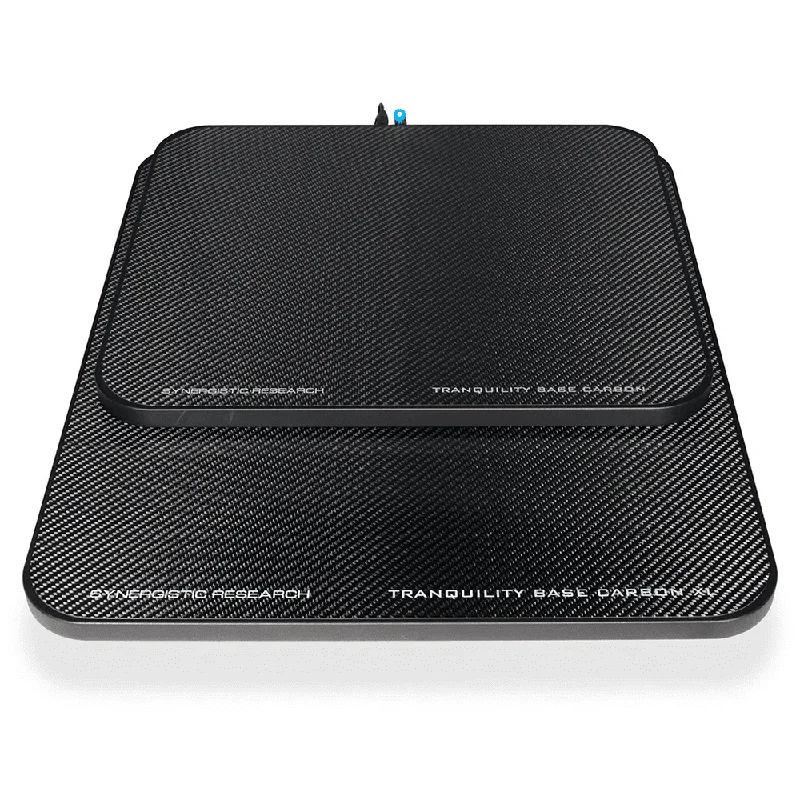
Introducing Tranquility Base Carbon, the first all-new Tranquility Base in over a decade. Synergistic Research started with a new chassis machined from a solid billet of aircraft aluminium for a 50% slimmer and 80% more rigid chassis. Synergistic Research then experimented with new laminates and arrived at carbon fibre for its superior response to mechanical and airborne vibrations. Synergistic Research then applied their most advanced EM Cell technology directly transferred from their Galileo SX PowerCell. Finally, its internal UEF Technology was transferred from their new state-of-the-art SRX cable loom. The net result is a thinner and more rigid Tranquility Base with a lower noise floor from which springs improved dynamics and soundstaging combined with smoother, more extended high frequencies.
Features
Condition at the source.
Tranquility Base history. Shortly after launching their first PowerCell line conditioner, their lead designer began work on a new application for his then new patent-pending EM Cell technology. It was early 2010, and Ted had the idea for an Electromagnetic Cell Field-Effect Conditioner capable of conditioning signal inside a component. First, Synergistic Research developed several flat EM Cells for placement below components running tests on multiple variants until Synergistic Research perfected an EM Cell capable of improving any component. Synergistic Research then experimented with different laminates engineered to cancel mechanical vibrations selecting the option that created the best sound quality. The first Tranquility Base was launched at the Rocky Mountain Audio Fest in late 2012. Three years later, Synergistic Research refreshed the Tranquility Base lineup in 2015 with the addition of UEF Technology. Synergistic Research have been building Tranquility Bases continuously since 2012 with minor running improvements along the way, but with no major overhaul or change to the fundamental design for the past decade, until now.
| Tranquility Base Carbon | Tranquility Base Carbon XL |
|---|---|
| Includes 1 sets of MiG 3.0 Isolation Footers | Includes 1 sets of MiG 3.0 Isolation Footers |
| 18.5W x 16D x 3/4H 180 sq/in Active UEF EM Cell Ground Plane Technology Solid Billet Aluminium with Carbon Fibre Top 1 Single Lead MPC Power Supply 1 sets MiG 2.0 |
20W x 23.25D x 3/4H 340 sq/in Active UEF EM Cell Ground Plane Technology Solid Billet Aluminium chassis with Carbon Fibre Top 1 Single Lead MPC Power Supply 1 sets MiG 2.0 |
Recommended components
Computer Audioa significant upgrade to MAC and PC based servers
Hard drivesA surprising but significant improvement
Under TurntablesImproves clarity and sound staging
CD Players, DACS and TransportsSound almost like Master Tapes
Pre-Amps
External Cross-overs
Amplifiers
One set MiG 3.0 included
Good things come in threes.
The new MiG 3.0 delivers an increased sense of space in the sound field plus improvements in low-frequency control and extension with high-frequency air and detail. All this with greatly enhanced resolution that is never fatiguing, plus a wall-to-wall holographic soundstage, including a sense of the performance enveloping your listening position. Listening notes: comparing MiGs to isolation footers based on dampening principles, you hear more extended dynamic range and spatial cues where dampened footers tend to have a flatter sound and lack dynamic extension. Isolation footers based primarily on draining mechanical vibration away from the component tend to sound bright with less sound stage layering and mid-range warmth when compared to MiGs. Lastly, if you have a full suite of SR Tech, your best possible footers will likely be MiGs, as they work on similar principles and have a similar house sound to SR cables, power products, and acoustic treatments.
Reviews
There are no reviews yet.